solutions
Outdoor wireless networks that cover acres, not aisles.
An outdoor wireless network extends Wi-Fi or CBRS across yards, lots, campuses, and fields where cabling every access point is impractical. The usual approach multiplies access points until the budget breaks. The Apogee architecture inverts it: fewer, higher-gain antennas that let the access points you already own cover more ground.
- Fewer access points
- 70 to 83 %
- Additional receive gain
- 24 dBi
- Client range
- 1000 ft
- Coverage per antenna
- 35 acres proven
how the architecture works
The problem is not transmit power. It is what your devices can hear.
01
Unlicensed power is capped
FCC rules cap client transmit power, so the limiting factor outdoors is what the device can send back, not what the access point can blast out.
02
Asymmetric Gain listens harder
Apogee adds up to 24 dBi of receive gain while keeping transmit gain FCC-compliant, so low-power field devices stay in the conversation.
03
Your access points, further
The architecture sits between the field and the access points you already run, so controllers, security, and day-two operations stay where they are.
deployment
One antenna where a dozen access points used to go
A typical outdoor deployment mounts one Apogee at height on a building edge, pole, or mast and aims it across the area to cover. The coverage plot here is a real design: a single antenna covering a 35-acre rail checkpoint, with clients connecting at the fence line.
Read the rail checkpoint case study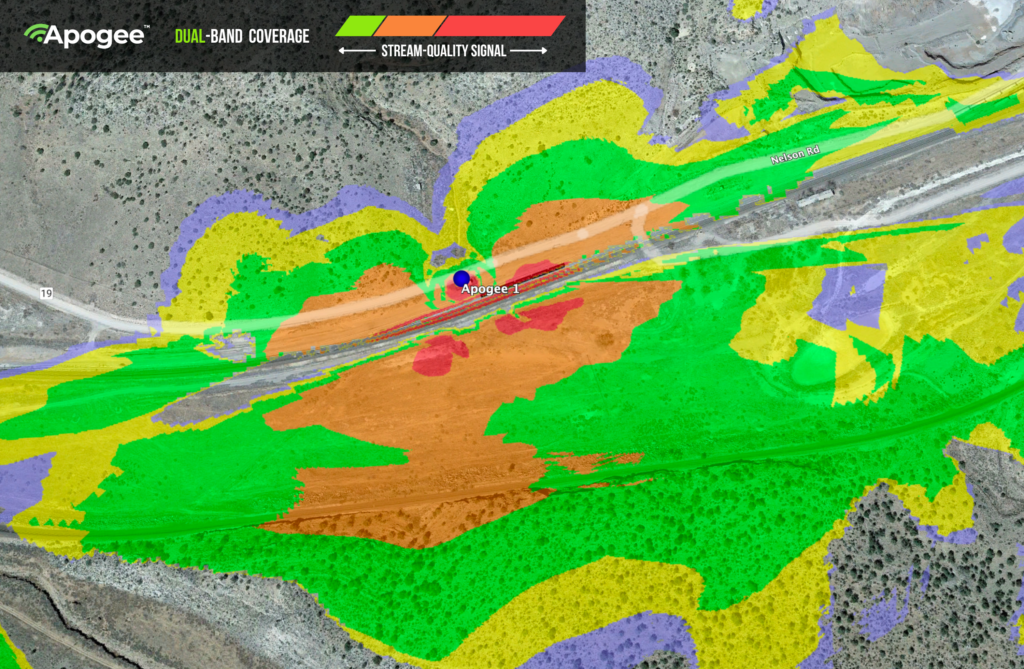
the solution underneath
Which Apogee fits an outdoor network
Outdoor wireless network FAQ
How far can an outdoor Wi-Fi network reach?
With a conventional access point, usable client range outdoors is often a few hundred feet. With Apogee receive gain, ordinary phones, tablets, and sensors can stay connected much further, including production coverage across 35 acres from one antenna.
Do I have to replace my access points?
No. Apogee attaches to the access points you already run, including Cisco Meraki, HPE / Juniper Networks, and Ruckus. Your controller, SSIDs, security, and management platform stay the same.
Is this a mesh network or point-to-point bridge?
Neither. Mesh nodes and bridges move traffic between fixed points. Apogee extends client coverage so phones, scanners, cameras, and sensors in the field connect directly.
What does weather do to it?
The family is built for outdoor mounting. The 360 and Converge are IP65-sealed and rated from -40 to +60 degrees C, and the 180 is rated from -40 to +70 degrees C.